
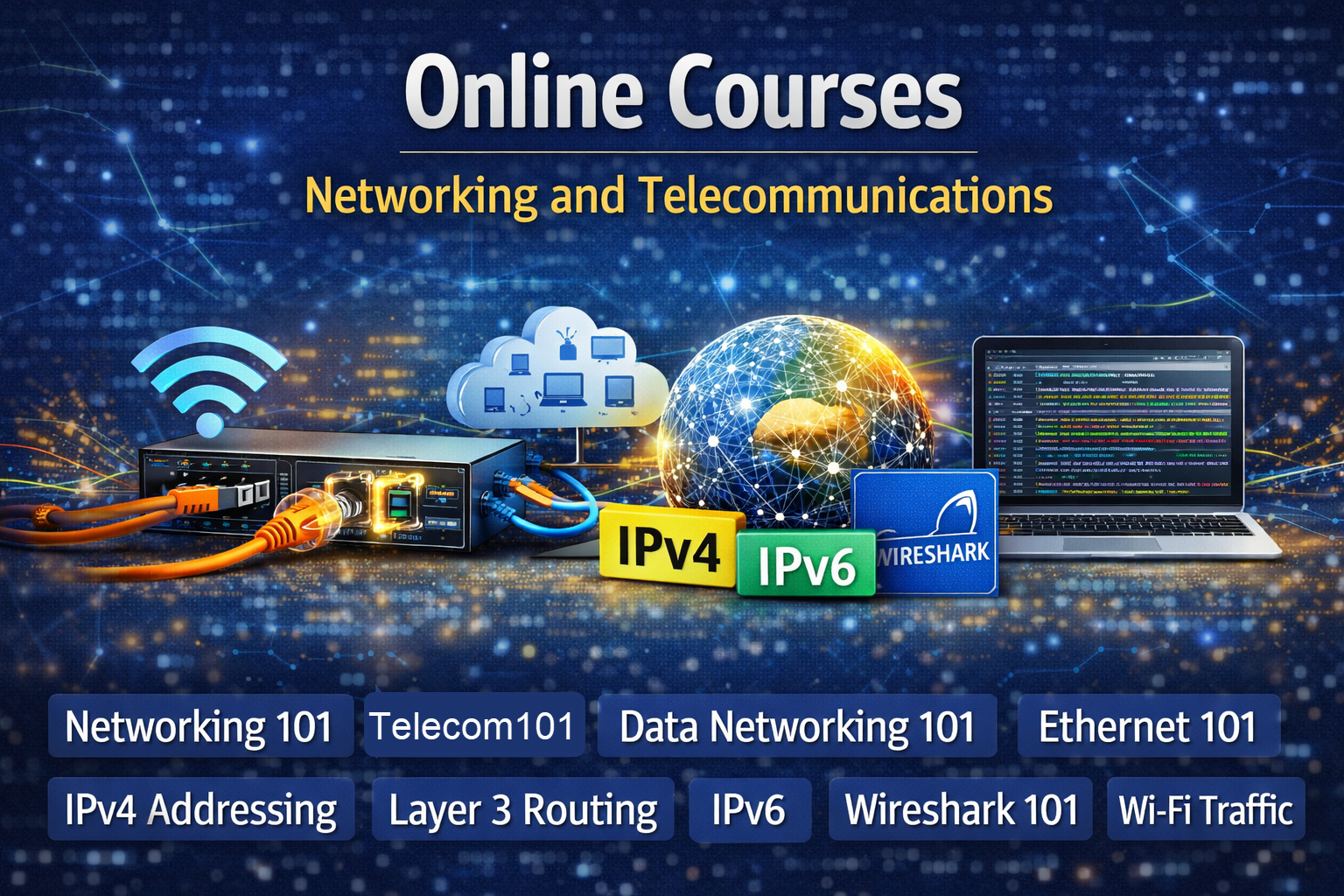
Welcome!  These are our Self Paced, Online Classes.

You must have an account here, which is free to create.  Once your account is created you can select and pay for these courses.

The courses are video lesson based, but they all have exercises and lab experiments that are either follow-me or step by step instructions for you to practice what you learn.  This is what makes our online courses better - more engaging - with higher retention.

You have 2 options to enroll in these courses:

  • you use PayPal to access each class (price is show in course title), or 
  • ask your employer for the "enrolment key" for the class.

Understanding the fundamentals of modern telecommunications networks is essential for service provider employees, including new hires, technical staff, and customer support teams. This one-day Telecom 101 course provides a clear introduction to the terminology, technologies, functions, and components that make up today’s voice and data networks.

The telecommunications industry has evolved rapidly, and the many buzzwords and acronyms used by experienced professionals can be overwhelming for those new to the field. This course demystifies those concepts by explaining how telecommunications systems developed—from Plain Old Telephone Service (POTS) to the modern Internet—and how today’s networks operate.

Participants will gain a practical overview of telecommunications terminology, network equipment, service architectures, and the regulatory environment that shapes the industry. The result is a strong foundational understanding of the technologies and infrastructure that power modern voice and data communications.

This course provides an introduction to the fundamental principles of data networking. Participants learn how communication networks are structured using layered models and how the TCP/IP protocol suite operates within that framework.

The course also explains how TCP/IP packets are transmitted and forwarded through networks, providing essential insight into how Ethernet and Internet technologies work together to enable modern data communications.

This course introduces the fundamental principles of Ethernet networking. Participants learn how Ethernet frames are structured and how Ethernet networks operate.

The course also explains key Ethernet protocols and behaviors, including ARP and Spanning Tree, providing a clear foundation for understanding how modern Ethernet networks function.

This course provides the essential knowledge and practical skills needed to understand and use IPv4 addressing. Anyone working with Internet technologies must understand the IPv4 addressing scheme and the historical developments that shaped how IPv4 is used in modern networks.

Participants learn the key concepts of IPv4 addressing, including classful and classless addressing, subnetting, and supernetting. The course simplifies these topics and provides the tools needed to confidently apply IPv4 addressing concepts in everyday networking tasks.

This course introduces the fundamentals of Layer 3 routing and the role routers play in IP networks. Participants learn how routers forward packets and make path selection decisions to efficiently deliver traffic across the Internet.

The course also explains key routing protocols used in the control plane, including RIP, OSPF, and BGP, and how they calculate optimal paths through the network. Understanding these mechanisms is essential to understanding how the Internet operates.

This Wireshark 101 course provides a fast introduction to using Wireshark for packet analysis. It is designed for beginners who want to quickly learn how to capture and analyze network traffic.

Participants learn how to configure Wireshark, capture packets, apply display filters, and customize the analysis environment. Even experienced users will gain valuable tips and techniques that can improve the way they use Wireshark for network troubleshooting and analysis.

This course explains how to capture Wi-Fi traffic using Wireshark. Participants learn the techniques required to properly capture WLAN traffic on Windows, macOS, and Debian-based Linux systems.

Capturing wireless traffic is often more complex than it first appears. This course breaks down the challenges and provides the tools, configuration steps, and practical guidance needed to successfully capture and begin analyzing Wi-Fi packets in Wireshark.

This course introduces the fundamentals of IPv6, the next generation Internet Protocol designed to replace IPv4 as global address space becomes exhausted.

Participants gain an overview of IPv6 concepts, addressing, and operation, along with the key differences between IPv4 and IPv6. The course provides a strong foundation for understanding how IPv6 works and why it is essential for the future of Internet networking.